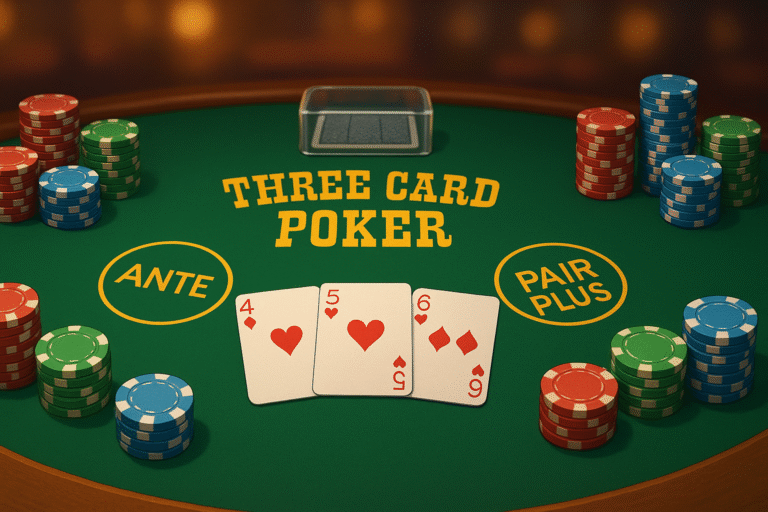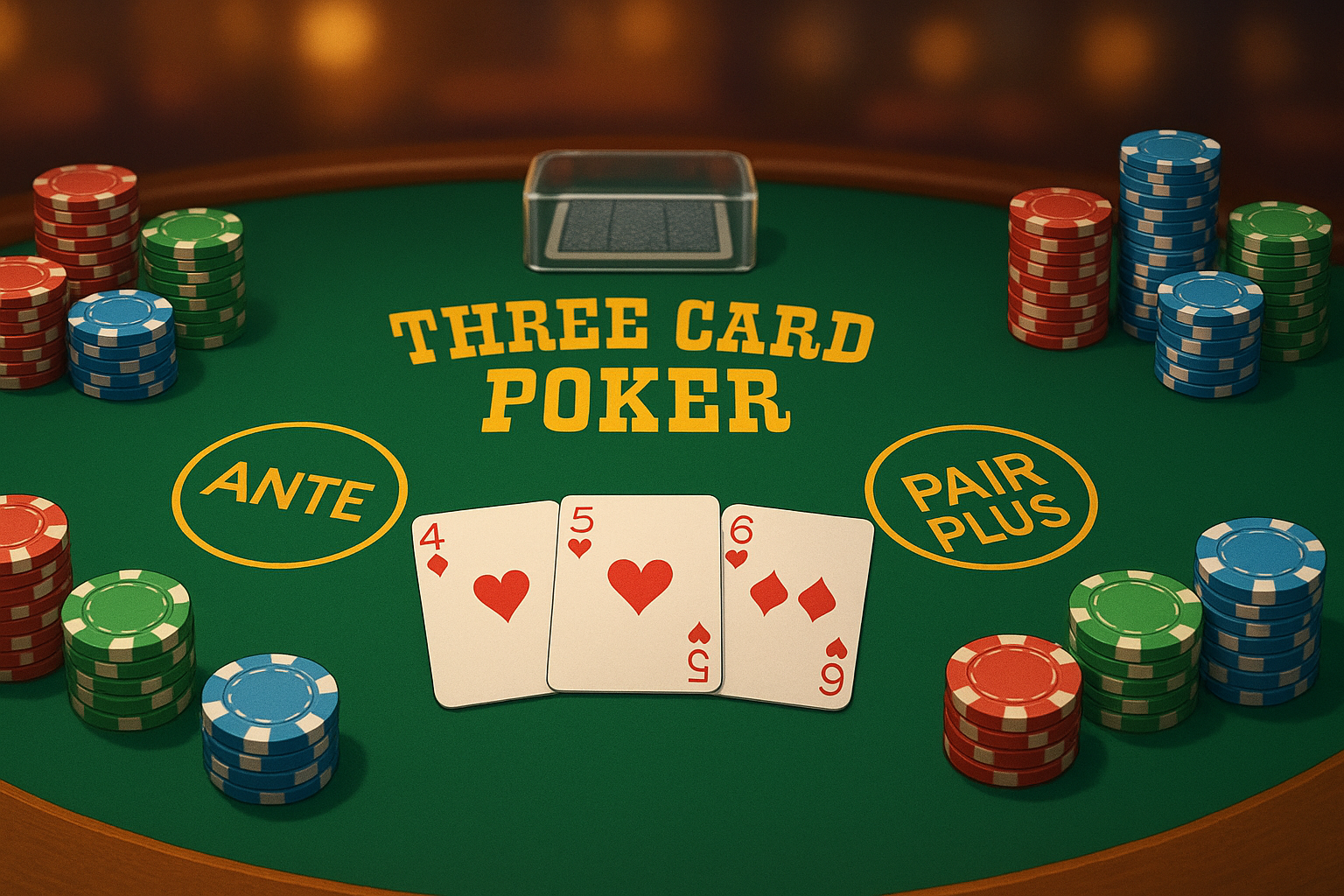
The Three Card Poker casino game is one of the easiest poker-style games you can play in a casino. Instead of battling multiple players with complex betting rounds, you simply try to make a better three-card hand than the dealer. With straightforward rules, fast action, and optional side bets for bonus payouts, it’s a great choice for beginners and casual players.
This guide explains how Three Card Poker works, the basic hand rankings, the main bets (Ante, Play, Pair Plus), and simple strategies to help you play smarter at the table.
What Is the Three Card Poker Casino Game?
Three Card Poker is a table game that combines elements of poker and simple house-banked games:
- You play against the dealer, not against other players.
- Both you and the dealer receive three cards each.
- The goal is to have a higher-ranking three-card poker hand than the dealer.
- Optional side bets pay extra if you make strong hands, regardless of whether the dealer beats you.
Because there is only one decision point—play or fold—it’s far simpler than traditional Texas Hold’em or Omaha.
Three Card Poker Hand Rankings
Three Card Poker uses unique three-card hand rankings that differ slightly from standard five-card poker. From highest to lowest:
- Straight Flush – Three cards in sequence, all the same suit (e.g., 7-8-9 of hearts).
- Three of a Kind – Three cards of the same rank (e.g., Q-Q-Q).
- Straight – Three cards in sequence, mixed suits (e.g., 4-5-6).
- Flush – Three cards of the same suit, not in sequence (e.g., 2-7-J of clubs).
- Pair – Two cards of the same rank (e.g., 9-9-K).
- High Card – None of the above; highest card plays (e.g., A-10-6).
Important difference: In Three Card Poker, a straight beats a flush, because it is harder to make with only three cards.
How to Play Three Card Poker Step by Step
A round of the Three Card Poker casino game is fast and simple.
1. Place Your Bets
At the start of each hand, you may place:
- An Ante bet – main bet against the dealer.
- Optional Pair Plus bet – side bet that pays if your three-card hand is a pair or better, no matter what the dealer has.
Many tables allow both bets, and some also offer an additional bonus side bet (like “Six Card Bonus”), but Ante and Pair Plus are the core.
2. Receive Your Three Cards
The dealer gives:
- Three cards face down to each player.
- Three cards face down to themselves.
You look at your cards and decide whether to play or fold.
3. Decide: Play or Fold
After viewing your hand:
- If you fold, you forfeit your Ante bet (and any optional Play bet you might have placed in variants where you bet up front); your Pair Plus bet (if placed) is still alive and will be resolved based on your cards.
- If you like your hand, you make a Play bet equal to your Ante bet. This means you’re challenging the dealer.
Now the dealer reveals their cards.
4. Dealer Qualification
For the Ante/Play bets, the dealer must “qualify” with at least:
- Queen-high or better (Q-high or stronger hand).
Two scenarios:
- Dealer does not qualify (J-high or lower):
- Your Ante bet is paid 1:1.
- Your Play bet pushes (returned to you).
- Dealer qualifies (Q-high or better):
- Your three-card hand is compared to the dealer’s.
- If your hand is higher, both Ante and Play pay 1:1.
- If your hand is lower, you lose both Ante and Play.
- If hands are exactly equal, both bets push.
5. Ante Bonus (for Strong Hands)
Many casinos offer an Ante Bonus for strong hands, regardless of what the dealer has:
- Straight or better often triggers a bonus payout on the Ante bet (for example, Straight, Three of a Kind, Straight Flush may have boosted payouts).
These bonuses are paid even if the dealer beats you on the main comparison.
6. Pair Plus Bet
The Pair Plus bet is resolved independently:
- If your hand is pair or better, it pays according to the Pair Plus paytable.
- If your hand is only high card, the Pair Plus bet loses.
Dealer qualification does not matter for Pair Plus; only your hand strength is relevant.
Common Payout Structures
Exact payouts can vary by casino, but typical paytables look like this:
Ante/Play
- Win vs dealer: 1 to 1 on Ante and Play.
- Dealer not qualified: 1 to 1 on Ante, Play pushes.
Ante Bonus (example)
- Straight: 1 to 1
- Three of a Kind: 4 to 1
- Straight Flush: 5 to 1
Pair Plus (example)
- Pair: 1 to 1 or higher
- Flush: 3 or 4 to 1
- Straight: 6 to 1
- Three of a Kind: 30 to 1
- Straight Flush: 40 to 1 or more
Always check the specific paytable at your table or online game, as it affects the house edge and potential returns.
House Edge Overview
The overall house edge in the Three Card Poker casino game depends on:
- The paytable used.
- Whether you play only Ante/Play, only Pair Plus, or both.
Typically:
- The Ante + Play game has a relatively low house edge when played with correct strategy.
- The Pair Plus bet usually has a higher house edge but offers big payouts for rare hands like Straight Flush and Three of a Kind.
For balanced play, many players use Ante/Play as the main bet and Pair Plus as a smaller side bet.
Basic Strategy for Three Card Poker
Three Card Poker is mostly about one key decision: when to play and when to fold. Fortunately, strategy is very simple.
1. Ante/Play Strategy: Q-6-4 Rule
The standard recommended strategy:
- Play (make the Play bet) if your hand is Queen-6-4 or better.
- Fold if your hand is worse than Queen-6-4.
What “Q-6-4 or better” means:
- Any hand with a pair or better is automatically a Play.
- Any Ace-high or King-high is a Play.
- For Queen-high hands, you look at the next cards:
- Q-7-x or higher → Play.
- Q-6-4 or better → Play.
- Q-6-3 or worse, or Q-5-x or lower → Fold.
Using this rule keeps the house edge near the mathematically optimal level.
2. Manage Pair Plus Carefully
For the Pair Plus bet:
- It can be fun and offers the chance for larger payouts.
- But the house edge is higher than on Ante/Play.
Good practice:
- Keep Pair Plus bet smaller than your Ante.
- Treat big wins (like Straight Flush) as rare bonuses.
Avoid betting large sums on Pair Plus alone.
3. Avoid Side Bets with Poor Paytables
Some tables add extra side bets (like “Six Card Bonus”) with tempting top prizes but very high house edges.
If you choose to play them:
- Use small stakes.
- See them as lottery-style add-ons, not your main strategy.
4. Bankroll Management
Because rounds are quick:
- Decide a session budget before you sit down.
- Choose Ante and Play amounts that allow you to enjoy at least 50–100 hands without risking your entire bankroll.
- Never chase losses by suddenly doubling your bets.
Setting a win goal and loss limit keeps your play controlled.
Online vs Live Three Card Poker
You can enjoy the Three Card Poker casino game in different formats.
Live Casino
- Real dealer, real cards, and table atmosphere.
- Social environment where you can talk with the dealer and other players.
- Slower pace but more immersive for many players.
Online RNG and Live Dealer
- RNG (Random Number Generator) versions: very fast, ideal for practice and low stakes.
- Live Dealer Three Card Poker streams a real dealer and table to your screen in real time.
- Both offer clear on-screen paytables and automatic payout calculation.
Choose whichever environment fits your style and budget.
Responsible Gambling
Even though Three Card Poker is simple and low-stress, it is still gambling:
- Only wager money you can afford to lose.
- Take breaks regularly, especially after long sessions.
- If you find yourself chasing losses or feeling out of control, step away and reassess.
Keeping a healthy mindset ensures the Three Card Poker casino game stays entertaining, not problematic.
Is the Three Card Poker Casino Game Right for You?
Three Card Poker is a great choice if you:
- Want a poker-style game without complex decisions.
- Prefer fast hands and simple betting options.
- Like the mix of steady main bets with the chance of big side-bet payouts.
- Enjoy both online casino play and live tables.
If you follow the basic Q-6-4 strategy and manage your bankroll, Three Card Poker can be one of the most enjoyable—and easy to learn—table games in the casino.
About the Author